
When I decided to take on the opportunity of meeting and later interviewing Phil Lewis, lead singer of L.A. Guns, I knew I would be facing a novel challenge. As a trained cultural anthropologist who only got to this point in my career as a consequence of being repeatedly vetted in research techniques, I have a difficult time cutting myself loose from my academic moorings. You see, anthropologists are a continually reflexive, introspective, self-questioning and self-doubting bunch who only ever achieve a tentative consensus on the “correct” way to do any sort of ethnographic field work. I guess you could say we have a problem that can at best be labelled as “indecisiveness” and at worst as low self-esteem. There are certain things, however, that are de rigeur for anthropological field research:
- The interlocutor (that’s the person you are studying / engaging with) is always right (meaning there is necessarily cultural significance to what they say and do in all cases).
- Objectivity is impossible; anthropologists comes to the plate with their own biases, and therefore interpret everything through their own lens of observation. We must try our best to become aware of these subjectivities, but ultimately we can not disassociate our analysis completely from them.
- Due to researcher subjectivity, providing the context for our work is important. We must set the scene for our readers.
- While it is not always possible, long-term participant observation is preferable.
- Interlocutors must give their informed consent to being observed.
- Their privacy must be assured at all costs…
- ….therefore you must make decisions (which are not always obvious) about which levels of transparency to adopt.
- Transparency doesn’t just include how much we share about our participants’ words and actions, but also our own.
- At the same time, if we exceed some indeterminable disciplinary threshold for how much we discuss our own presence as researchers, then we are no longer being”epistemically productive.” Then we are just being narcissistically autobiographic.
- Through conversation, we often build friendships with our interlocutors.
- Because we become friends, we learn that they are human beings with quirks, both entirely delightful and occasionally frustrating.
If all these caveats haven’t already made you go cross-eyed, then congratulations. Anthropology (and Nexium?) might be right for you! It’s really quite a lot to juggle, all these concerns about analytical robustness, ethics, privacy and consent, and on top of that, making the acquaintance of a public figure was entirely new terrain for me. Seasoned ethnographers, I suppose, get used to the grey area through which they must duet with their interlocutors, and as far as rock musicians go, they probably are better equipped to handle this ambiguity than others. Not only are they used to “the gaze” of observation due to being on stage, as well as putting on personas according to environment and event, but (at least in theory) they consider it a matter of course that work (the rational, the objective) and leisure (the emotional, the physical, the subjective) are not mutually exclusive. If they were, they would never be artistically inspired or creatively productive. Legendary rockers have traditionally thrived on discarding “9-5” routines and etiquettes and just getting on with the Dionysian buffet of life, in which intellectualism and feeling and not strange bedfellows.
And there is yet another dimension to add to this strange brew of music anthropology: gender. As a female researcher who has become increasing involved in a male-dominated sphere (rock music), I’ve long been cognizant of the reality that that the “fantasy of freedom” that rock has been said to provide to both to its male practitioners and followers has been largely denied to its female constituency. While a female rock guitarist such as Lita Ford says, “I wear my balls on my chest,” (a statement which reveals her complex status as both a sex object and a spectacle of power in heavy metal), the implication about women who have surrounded male rock musicians – through the sharing of space, time, ideas, energy and resources – has been that their sexuality is their primary (if only) exchange commodity. The notion of symbiotic relationships existing between male musicians and female professionals, or conversely, that these women might have goals and motivations of their own (which may or may not always overlap with those of male rockers) is usually not considered, and if it is considered, it is almost always negated. For example, according to scholar Lisa Rhodes, author of Electric Ladyland, starting with the release of Rolling Stone’s “groupie issue” in 1969, not only were all “groupies” limited to the potential sexual function they could provide musicians, but doubt was cast onto the motivations of female journalists and other women working in the music business: “ [They] never were groupies in the strict sense, but are, somehow, cut of the same fabric.”
Bottom line: there has been a palpable lack of discussion about women in these spheres who have transcended divisions between the professional and the social, and gendered cultural negotiations in the 1980s scene along the Sunset Strip have been especially neglected, perhaps because misogyny in heavy metal/hair metal was regarded as so blatant that it required no deeper consideration (Case in point: https://www.youtube.com/watch?v=E8aD5zKPg4A).
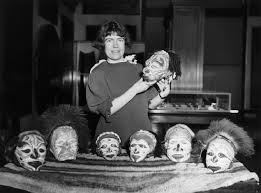
From the beginning, Phil Lewis seemed to intuitively understand these intricacies. Whether this is symptomatic of being boarding school educated in Surrey, being engaged as a young man to the sophisticated and eloquent “goddess of the silver screen” Britt Ekland (who I get the impression wouldn’t put up with a lot of nonsense), his exposure to other cultures through constant touring as a musician, or just simply being of a certain age, I haven’t a clue. Perhaps he is the reincarnation of Margaret Mead.
In any case, he got the knack for what ethnographic field work is based upon, which is to be in the thick of things, and not just for the sake of observation, but through a lot of ongoing and extended dialogue about many aspects of rock culture past, present, and future. Most strikingly, compared to other individuals in the rock world with whom I’ve worked in the past, he didn’t expect me to know every facet of his biography prior to contacting him; discussions didn’t need to be diverted back to L.A. Guns or Phil Lewis . In fact, at this point in his career, I got the sense (reading between the lines) that he views these standard interview formats rather prosaically.
After discussing my research (which is stalled for lack of funding), my three dogs (he’s a “cat person”, by the way), my vegetarianism and my new (old) car’s lack of air conditioning with Phil Lewis via email for about a month, he offered me a great potential experience: the opportunity to tag along with L.A. Guns for an evening when they were to be performing at a venue close to Dayton, Ohio. I figured this would be the closest I’d ever get to being a music journalist like Robert Christgau, Nick Kent or a teenage Cameron Crowe (but who at the same time would look as adorable as Kate Hudson’s Penny Lane in her furry coat and platforms), so despite some initial hesitation (I had only recently bought my first car – a used Honda CR-V, so this meant I would have to drive on the freeway for almost the first time in my life), I decided to dive in head first.
Phil invited me to meet him at the hotel, so that I would be able to see all the pre-gig action (or lack there of). I don’t recall his exact words, but he indicated that I might find it humorous or interesting due to its very mundaneness – something to that effect. So after pulling up to L.A. Guns’ Dayton area accommodation that September afternoon and sending Phil a text to let him know I had arrived, he offered to meet me in the lobby. I said it wasn’t necessary, but upon walking into the lobby, I realized that this was my first mistake of the evening. While the hotel staff (an exhausted elderly woman and a portly hotel maintenance man) took a long look at me in my black dress, stilettos, faux leather jacket and dark red lip stick, I could only imagine what they were thinking. As images of villagers with pitchforks shouting obscenities about “women of the night” floated in front of my mind’s eye, I muttered something about being there to meet “one of their guests” and scurried past the front desk. I wondered if my outfit was maybe a bit much (an over-correction, perhaps, from my Mary Poppins-esque attire at the Whisky a few months prior), but I figured it best to try to match the band as much as possible for the evening (I wanted to be as inconspicuous as possible once we were at the gig). And let’s face it, they like black, leather and eyeliner.
Anyway, as I lifted my hand to knock on Mr. Lewis’s door, I realized – to my astonishment – that it was shaking. I didn’t expect nerves; at this point in my life, I’d been in some pretty one-of-a-kind experiences as a practicing cultural anthropologist overseas (e.g. nearly being assaulted by a group of drunk men who reeked of Starobrno pilsner while waiting for an early morning bus in Moravia; living in a Roma (“gypsy”) ghetto in the Czech Republic), so I didn’t think meeting a rock star would phase me very much. My nerves only became more evident when a few minutes later, he handed me tea (yes, he’s English so of course there was tea) in one of those tiny styrofoam cups that comes with respectively tiny hotel coffee machines. My hand got so jittery that I almost spilled it on his leather jacket, which was lying on the arm of the couch next to me.
Sorry, I’m skipping steps. Okay, so Phil answered the door in his track pants and black t-shirt and quickly welcomed me in, then after some pleasantries and the offering of tea, we chatted for about a half hour about music and the industry, Bobbie Brown and the “Cherry Pie” video (Warrant was also going to be performing this evening), and how I saw a photo on Facebook of Tawny Kitaen (the redhead who does cartwheels on car hoods in Whitesnake’s “Here I Go Again” video) snogging him while he was in the middle of performing a few years ago. I mentioned how “fascinating” groupies are to me. Phil giggled at this. “From an academic point of view of course,” I clarified. “We tend to be fascinated with those we don’t understand, right?” He nodded. “I’ve got to get ready now!” he exclaimed, rushing to his suitcase.
As Phil took his stack of black garments into the bathroom to get ready, I sat on the couch sipping my tea, and as usual, ruminating on my own social-psychological cud, only this time to the melody of “Sex Action” and its associated music video imagery of leggy 80s Sunset Strip women canoodling with Phil Lewis in a convertible parked somewhere in the Hollywood Hills. I was fully aware that I might be interpreted by others backstage as a “groupie”, a hanger-on, or some other sort of arm candy, but at this point, I wasn’t sure if I could say I wasn’t one (I did look pretty smashing that evening, and I was “hanging around” rock musicians without much explanation given to anyone else about who I was other than “his friend”). On the other hand, both Phil and I knew my professional motivations for being there. And then of course, there has always been a small part of me that is iconoclastic enough to want to throw people’s subconscious and societally engrained patriarchal assumptions back in their faces. To sum it up for the anthropologically inclined out there, my experience that evening could be described as one of liminality – of ambiguity, disorientation and fluidity. I was standing at the threshold, not only of a number of categorizations that would be utilized by others, but also at the boundaries of a lot of my own modes of self-identification.
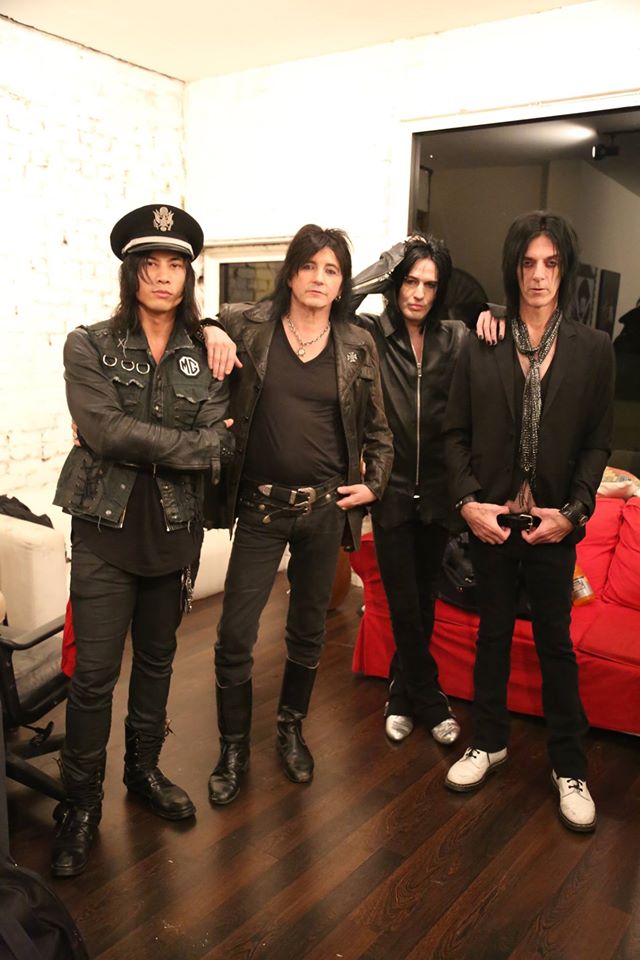
Venturing out into the hallway, I was cast headlong into this ambivalent “space” when Phil introduced me first to his tour manager, Jeff, and secondly to L.A. Guns’ drummer Steve Riley. Whereas Jeff gave me a beleaguered look with a slight side of skepticism, Steve barely skipped a beat and asked Phil for an update on when they were supposed to meet out in the van. Once in the van, things only got stranger (for me). Phil and I sat behind and a row removed from Jeff and Kenny Kweens, with Steve behind the wheel (he likes to drive) and Michael Grant riding shotgun. I saw Jeff and Kenny look at each other and roll their eyes, motioning back towards Phil and me, and one of them said, “Hey Phil! What are you doing all the way back there?” I immediately tensed up and felt like slinking down into my seat, or even better, under it. Get me out of here! This was my gut-level impulse, a reaction that was thrown into contrast even more once I took a moment to consider how the female legions of L.A. Guns fans might feel if they were in my black suede heels at that moment. Flattered? Humored? Indifferent?
I gave Phil a sideways glance, who at that moment was seemingly more interested in looking out the window at the I-75 scenery flying by and quizzing me on my historical knowledge (the War of 1812 if I remember correctly) than by his comrades teasing. Or else, he had tuned it out. I did a study of his profile. At 58, he was just over 25 years my senior. If any one of his band members had turned around to take in the odd image the two of us presented, they would have found something akin to a tart-y Audrey Hepburn sitting next to a long-haired, Sons of Anarchy-style Montgomery Clift. With his dyed black-blue tresses, chiseled facial features, creamy complexion and lithe physique, he cut a very attractive figure. It must be all the resveratrol from the red wine he drinks, I thought to myself. Hearing his London accent made me feel at ease in a way, given that I had spent some of the most important years of my adult life thus far in the UK. He had told me a little about his childhood, and although I hadn’t known him for long, it was clear from what he had revealed to me that he was a survivor. Whereas he had too much freedom at a young age, I had had too little. Yet at the same time, we had both had absent paternal figures. It was an interesting study in contrasts…about how extreme childhoods can mold and guide you, even into your adult years.
Once at the concert, L.A. Guns sprang into action unloading their gear and settling in, but not without noting how 1) there were no bathrooms for them, let alone a green room, and 2) how astoundingly hungry they were. We were outside, stationed between the back of the venue’s building and a tall concrete wall covered with weeds (which was itself a haven for mosquitos). As I intermittently smacked my exposed flesh, I chatted a bit with all the band members – with Steve Riley about Deep Purple and Guns N’ Roses, with Kenny Kweens about our mutual ownership of poodles, and with Michael Grant…. Well, to be honest, I don’t remember what I spoke to him about, but this is because any conversation I had with him was to be quickly overshadowed by the arrival of my best friend from elementary school, Sofia (Phil had told me to feel free to bring a friend with me as well). Michael, who was at this point in seventh heaven with the pub-style appetizers, became fast friends with her over their mutual love of the chicken wings. “Oh my god! These are sooooo good!” they exclaimed, digging in. I realized that my choice of guest was a good one, especially later on; Michael Grant, who was suffering from a bad cold, stimulated Sofia’s motherly instinct, and before she started her drive home to Kentucky, she went down the street to Wal-Mart to buy him some Sudafed and a scarf. Sofia’s announcement that she was about to initiate her journey home across state lines served only to further confuse Michael’s decongestant-addled brain. “Kentucky?” he said. “Where the hell are we?!?” Sorry Dayton, OH. The impression you left on L.A. Guns’ guitarist that night was not an enduring one.
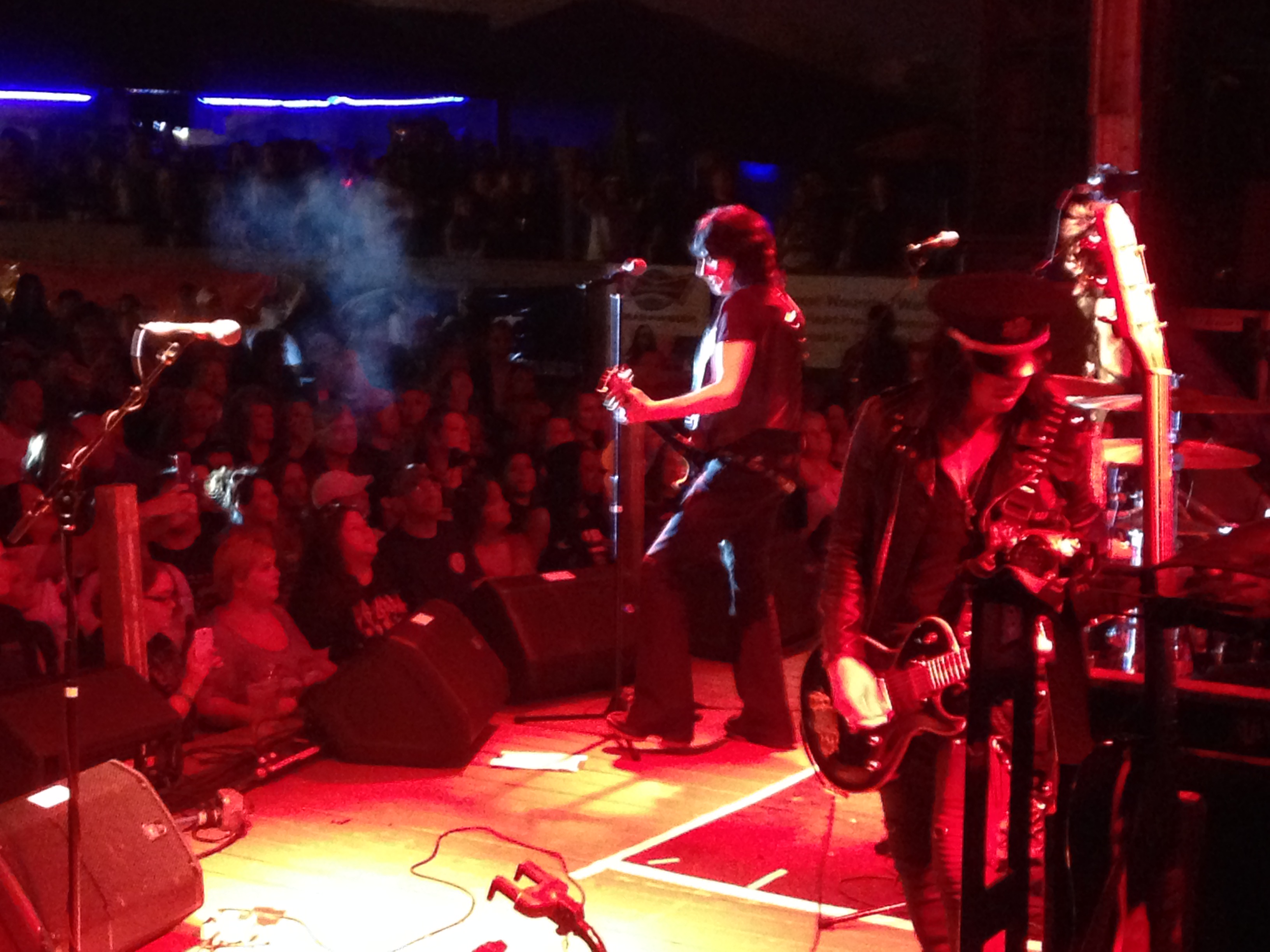
I got to experience the L.A. Guns concert from stage left, right next to the sound control station. It was a perfect location for me: I felt in the middle of everything, yet I was concealed enough so that no one would notice me. I felt like part of the audience, but I also shared some of the vantage point enjoyed by the musicians. All of my senses were activated, and at long last, I felt that I could shut off the “research” region of my brain. For a very brief moment, I could begin to understand the “high” that “groupies” might get from sharing space and time with rock musicians. For some women, being that close to unadulterated energy (i.e. powerchords!) and to culturally-celebrated demonstrations of masculinity could surely be intoxicating.
In her book Let’s Spend the Night Together, Pamela Des Barres says that the role of a “groupie” isn’t to cook a rocker dinner, do his laundry or share his bed, but to be a muse, since “all creative souls need passionate encouragement from devoted admirers.” My evening with L.A. Guns, however, led me to a different conclusion and an alternative view about how woman might engage with male rock musicians – a view that is shared by music sociologists like Robert Walser: they can be our creative muses and empowering idols. At one point in our correspondence, Phil Lewis remarked that I seem like a very analytical sort of person. I am sure from an artist’s perspective, that’s a natural and completely understandable conclusion, but in fact, one of the factors that has led me to do research in music anthropology is my need to do work with which I have an emotional connection.
Furthermore, male rock musicians are my inspiration for everyday life. For example, without even realizing it, in many cases parents raise their daughters to not be too assertive, outspoken, or demonstrative. It is no surprise, then, that a “f*&k you” attitude doesn’t come easily to a lot of women; it certainly hasn’t for me, but it is occasionally essential for survival, I’ve learned.
So according to this definition of the term, I am not groupie material (which I guess is good, since it unfortunately has taken on a pejorative tone in popular culture despite the current “post-feminist” moment we are living in. The only solution I can figure out is that I obviously need to have a band of merry rock star troubadours / admirers follow me around so that I can always be creatively productive. Male groupies are a thing, right?
Just kidding.

 intellectualgroupie