


Rock idol. Guitar god. Pop star. In Western society, music and mythology are not strange bedfellows. During our teenage years, we tend to deify our favorite rock musicians, to tape their posters on our walls as if they’re some sort of religious icon. We go to concerts and stand in awe of these “rock shamans” (think Jim Morrison), who go to emotional places where most of us are too afraid to tread. In the age of social media, many have transferred their teenage idolization of 80s rock stars into an ardent, middle-aged participation in Facebook fan pages and chat forums like Metal Sludge (although if you’re familiar with that platform, you know it tends more towards desecration of “washed up” musicians than worship).
Where, however, are women in this pantheon of rock deities? To be certain, there are fierce women in the glam rock / heavy metal genre (Joan Jett and Lita Ford are a few with high name recognition), but, for whatever reason (and I have a few ideas, but they are outside the scope of this piece), our culture generally isn’t inclined towards sanctifying them in quite the same way as male rock guitarists or vocalists. Perhaps it’s because while female rock musicians have had to push the boundaries out of necessity, male musicians get their “street cred” by making it their default mode of operation.
Take, for example, the following Greek parable, and tell me you can’t quite easily imagine your favorite ballsy rock star in the leading role: We’ve all at least heard of Narcissus before, right? He’s the guy who falls in love in with his own reflection until he dies. The point of the story is that becoming self-absorbed can lead to one’s own destruction. Well there are other important (female) details to this story that often get left out. Narcissus isn’t a god, but as the son of a river god and a nymph, he’s technically a demigod, and as such, inherently possesses some qualities that give him an edge in life amongst the mortals. To start with, he’s easy on the eyes. He’s a hunter, an occupation that some women might take as proof of virility and coordination (this probably also means he owns leather pants). These rather superficial attributes are enough to hook Echo, a mountain nymph who can only utter the tail end of others’ words. This is a pretty big relationship challenge, wouldn’t you say? It means that she can only tell him she loves him if he says it first. Echo is eventually able to express her love, but unfortunately for her, when he says it, he’s gazing at himself. Thus Echo is quite literally condemned to repeat ad infinitum Narcissus’s self-love. As his “backup singer” (her name is Echo, after all) she’s useful, but her role is tragically redundant because there are many other mountain nymphs who are just jonesin’ for the opportunity to be in Golden Boy’s orbit).
Narcissus’s pride and disdain for those who worship him the most are, intriguingly (and perhaps even comically) part of his allure. Except for Nemesis, that is. Nemesis is a goddess who’s woke af and doesn’t have any patience for his “bad boy” shtick. She’s taken it upon herself to enact revenge against those who succumb to their own arrogance. “Who does this Narcissus guy think he is?” Nemesis asks. “It’s not like he’s even a true god. He’s only a demigod. He’s just being downright disrespectful to the real deities. I’ll show him what it’s like to be fooled by a beautiful façade.” And so, Nemesis attracts Narcissus to the pool where he falls hopelessly in love with the wavy blonde locks and symmetrical face he sees in front of him. Of course he doesn’t realize it’s just an image, but that’s his tragic fate: to be addicted to his false self to the detriment of his real self (the one that’s flawed and human, and like, needs calories and stuff to survive).
Ex-Wives of Rock, a reality series that featured Athena Bass, Bobbie Brown, Shares Neil, and Susan Blue Ashley, is like a women-centered “take two” of the Narcissus myth. Although as the wives and girlfriends of 80s rock stars, these women never occupied the sycophantic “fan girl” territory of a figure like Echo, there is no question that they now are their own unique versions of Nemesis. As the partners of 80s “rock gods” like Vince Neil and Tommy Lee, they got to routinely hang out in the VIP areas of the Sunset Strip (Mt. Olympus), and by sharing their daily lives with these rock deities and being the (primary) objects of their affection, they became demi-goddesses themselves. Alas, they also learned that their partners, as pseudo-religious rock idols, considered themselves to live according to a different set of rules. “I’m a god! I don’t live in the mortal world of cause and effect!” one exclaimed, as his girlfriend heard giggling groupies on the other end of a phone call. Another of these rock gods exclaimed, “I don’t need rehab! Rehab’s for losers!” as his partner saw a mysterious woman on the other end of an intergalactic Skype video conversation.
When a rock god, who once shined his heavenly light upon you, becomes a full-blown Narcissus, there are two options: 1) As an Echo, you can find another rock god to, well, echo. But that means you also must live with the knowledge that your relationship will always be asymmetrical (you’re a mortal, or at best, a demi-goddess; he’s a god who’s been ordained as such by his fan base – ahem – congregation). Or 2) you toss yourself out of Mt. Olympus (or the VIP lounge of the Rainbow Room…Whatever!) down to the mortal realm because you realize that your relationship with “Rock God” was much too labor intensive, and all that time you were putting into propping him up can now be invested into deifying yourself. In other words, you can turn yourself into a goddess ( Hello Nemesis!).
They’ve had some ups and downs, but in 2017, Athena Bass and Bobbie Brown are both living Option 2. I chatted with both of them (on separate occasions) in L.A. last month: with Bobbie in her convertible outside a Coffee Bean and Tea Leaf, and with Athena and her daughter Tobi in a surreal diner that had such hilariously slow service that I thought I had been transported into Twin Peaks. Read on for my interview with Athena, and please click here for my interview with Bobbie.
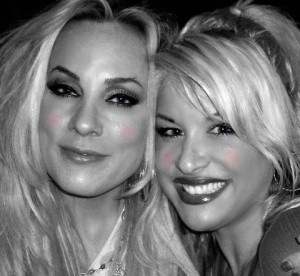
Intellectual Groupie (IG): Hi!
Athena Bass: Hi! We’re finally here.
IG: Athena, I’ve read that you are working on a proposal for an autobiographical book, Coming in Second. Is this a different one from the book you mentioned in interviews a few years ago, or have you re-initiated the project?
AB: No, actually it’s the same one, and I’ve been working on it. What wound up happening is that the proposal is done and it’s ready to go, but I want to wait on it because right now, I don’t really like the ending because it kind of goes along with my life, so there’s part of it right now that’s actually really negative, and I don’t want that, I want to have better things to –
IG: So the timing is off?
AB: Yeah. Exactly. I’m thinking probably I would like to give it one more year, and then either way, I’m just going to go ahead and let it go.
IG: And so, I’m curious, are you doing that through self-publishing?
AB: No, I have a ghost writer, Carolyn Ryder, the same one who did Bobbie’s book. And then, from there, there’s a lawyer, Adam, the same one who did Bobbie’s deal. He’s going to take it wherever he thinks it will work out best.
IG: (Auto)biographies about 80s musicians and bands and those involved in this music genre have become especially numerous in recent years. What are your thoughts on these books? What would you like to see more of? Less of? Are there any individuals from the Sunset Strip scene whose life stories you’d especially love to see in print?
AB: You know what? I actually just read a book by Sebastian Bach, and he’s a friend of mine so it was kind of trippy to read it. I’ve read books by a few others, but his was the most honest. If you get a chance, read his book because it’s super honest. A lot of people – I don’t know if it’s something I should say, but I read a book once by Bobby Blotzer, who was also a friend, and I read the book, and I was actually pretty bummed out because basically it’s just a book burning on people. And you know, that’s not what I expected. Well, not not what I expected, but it just wasn’t a good thing to read. It was just him and his feelings on all these people and it was just super negative, is what I’m saying. And Sebastian’s book actually tells a story. You know? He tells the fun part and he tells the shitty part. And he gets into himself too. He’s not in there just talking about how great he is and the life he had and this and that. He gets real and that’s pretty cool because a few that I read which I won’t even mention, well, they’re bullshit. And I know for a fact they are because I see people putting out stories where they talk about everything going on during an overdose. How do you know? How do you remember all this kind of stuff? Those are the kind of stories that sort of weird me out because I can tell you myself, I’ve been completely drunk and there’s no way I can tell you exactly what happened in a 24 hour period. So how can somebody who’s in the middle of an OD? You know what I mean?
IG: Yeah, I do. I’m an anthropologist, so I study human cultures. And that’s why I’m interested in 80s glam rock and how it’s come back and become integrated with social media because it was a music scene that was pretty much totally physically anchored in Hollywood –
AB: And thank God there was no Twitter or Instagram back then ‘cause half these people – you have no idea. It’s funny. We sit together and a lot of times we’ll just look at each other and go, “Thank God nobody could see what we were doing.” [laughing] “Our lives would be ruined!”
IG: Yeah, I’m actually going to ask you about that in a little bit! Anyway, what I was going to tell you is that when I was in graduate school, I lived in the Czech Republic for a year of my life collecting the life histories of Romani, or Gypsy women.
AB: Whoa.
IG: So there were a lot of times when I couldn’t tell if what they were telling me was accurate or not, you know, when they were recollecting things, and I asked my thesis advisor, “What if they’re lying to me?” And he said, “Well, that’s really not the point. It’s interesting why they’re telling you something in a certain way because they’re doing it for a reason.” But obviously autobiography is a bit different because they whole point of it is that people want to read it because they want to know about your life. So I do think that is sort of a problem, that some people might be intentionally deceptive. But some of it is just that each of us is also going to have our subjective point of view on things that we’ve done in the past. Bobbie said that she actually put that in her book. “This is how I remember things.” But it sounds like what you’re saying is that people are just making stuff up or embellishing or –
AB: Well yeah, a little bit. It’s more like they think it just sounds better, or it makes the story more exciting. But it’s not true.
IG: Okay, so you’d definitely like to see less of that.
AB: Yeah, I mean, if you’re going to tell a story, just be honest, and if you don’t like something, leave it out. Don’t put it in and make it sound better. Just leave it out. Be honest for once because (if you’re not) then it’s not really your story. It’s a story you just made up.
IG: In an interview with Sleaze Roxx, Lorraine Lewis mentioned several times the significant nostalgia she was feeling when Guns N’ Roses played at the Troubadour at the beginning of their reunion tour. She also says that nostalgia was behind the re-launching of Femme Fatale. Do you think it is simply nostalgia that drives the continuance of “retro” music events like Farm Rock Nashville, Cathouse Live, and Monsters of Rock cruises, or do you think there are other motivators besides sentimentality?
AB: Yeah that, and the fact that for a lot of these people, those were the best years of their lives. And they refuse to let them go.
IG: The people who are going as guests?
AB: Yeah… and some of these band members too. That was the best time of their lives so they’re just not willing to let it go. I’ve seen some people who still have their same haircut, or the same pants or shoes or whatever because they just refuse to stop living it. [laughing] You know? It was a good time for a lot of people. It was pretty free. Then eventually they had to grow up, get married, get serious… We didn’t have our phones and stuff like that. We all knew that every single night we were going to meet either at the Troubadour or the Rainbow. And any single night you could go out and you knew where all your friends were going to be.
IG: What about people who were so young they didn’t ever live through those days, but who are now going to these events?
AB: You mean like when you see little kids at these things?
IG: Yeah, or teenagers. Do you think it’s their parents who are getting them into it?
AB: I don’t know. Some of the music was really good, so they might just like it. I’ve seen little kids at some shows and they sing every single word. It’s pretty cool. [laughing]
IG: How do you think social media has impacted the experiences of music audiences and fans? You know because before, people would definitely need to go to concerts or bars, or they bought magazines, but now they can interact with artists online.
AB: Yeah, that’s really cool. It’s really cool that your hero can tweet you back because that didn’t happen before, but the part that blows is when you’re at a live show, and you’re watching the whole thing through your phone instead of being there, being in the moment. I’ll go to a show and I won’t even take my phone out. I rarely if ever take pictures at shows because I want to be there and enjoy it. I get that you want to have it for later, but at the same time, for me it’s kind of like, well a million other people are taping it too. You know, just watch their tape. I feel that it takes away from being there 100 percent. But it’s just different. They don’t see it that way. For them it’s cool that they get to be there and they get to tape it. It’s just a different generation, that’s all.
IG: Yeah, it’s strange. I’ve thought about this, and it kind of seems like it would make a more lasting memory if you were just paying attention as opposed to doing a tape that’s essentially going to be the same as every other video.
AB: You miss a lot when you view a show through a phone. You really do.
IG: Does that stand out to you when you’re playing as well?
AB: No, I don’t care either way. However you want to watch the show is your deal, so it doesn’t make a difference to me. But as a person watching, I want the full effect. I don’t want a phone in my hand. I want to be present. But if I’m playing and I see someone with their cell phone, it doesn’t affect me either way. I know some people get pissed off by that, and I’m like, “Why? It’s just how they want to watch it.”
IG: You and Bobbie are on social media. What has been most surprising to you during your interactions with fans?
AB: How cool people are, really. There’s a lot of cool people. Yeah! Every once in a while, there will be an asshole somewhere, but not really.
IG: Bobbie actually said exactly the opposite!
AB: She gets haters. She gets them. I don’t know why.
IG: She was saying that she can’t imagine someone coming up to her and cursing and saying what they’re saying to her on social media.
AB: Oh yeah, they get ballsy.
IG: Yeah, do you think it’s the anonymity of it?
AB: Oh yeah.
IG: I guess it’s not anonymity though because you can still see their name.
AB: Yeah, but I’ve seen some comments before, and I just say in my head, you know for a fact that if that person was standing in front of you, they would be standing with their tail between their legs or running away. There’s no way that would be coming out of their mouth if they were speaking directly to someone. But Bobbie – I don’t know why, but it’s like she’s a psycho magnet. Even guys. They’ll come at her with some of the craziest, meanest, kind of stuff. And she interacts with them. If that were me, I’d just be like, “Oh no you didn’t!” But Bobbie talks to these people. I don’t know. We have a whole different (way of interacting with people on social media), me and her.
IG: Do you think it might have to do with the thing that she’s most known for, which is the “Cherry Pie” video? Because it was relatively sexualized.
AB: Yeah! I don’t really know. I don’t know why people choose to go off on her. She’s so cool. Well you know. You met her!
IG: Yeah, well she seems very open, and I think sometimes that can also invite (the crazies).
Tobi (Athena’s Daughter): It’s also probably because in the 80s, their boyfriends were obsessed with her and they have pent up animosity. I mean the older women who comment.
AB: Oh, that could be! Yeah, and you know there were a lot of women who were after the guys that she was with.
IG: This is kind of in line with this topic. One thing we hear about people on social media is that they engage in “impression management,” for example, that they only share certain photos of themselves because they want to look their best, or they only share the best aspects of their lives.
AB: Right. I know people who live a complete fantasy on the internet, and it’s nothing like their actual life.
IG: But at the same time, people have easy access to snapshots of public figures’ lives because they’re on social media. So how do you think this figures into how fans engage with musicians online? Because I think fans think that what they see is musicians’ (complete) real lives. But they’re editing what they put up there just like everyone else.
AB: Of course they do. No one’s going to go on there and say, “Hey! My life sucks right now.” No, it will be, “Everything’s great, everything’s cool.” They’re just like everyone else. Everyone does that.
IG: I think it’s weird though because back in the day, it would have just been interviews with musicians in magazines, which is more structured. Now online, it gives the façade of being real, when in fact it’s still structured.
AB: Yeah, I don’t understand. A lot of people want to believe that stuff, like that everything that (their idols) say is real.
IG: Yeah, besides the musicians, I also think that a lot of the fans that follow them online are living a sort of fantasy life on there. It’s like they’re getting something out of it that they’re not getting in real life.
AB: Okay, so I’m going to try to explain this in a super easy way. There are some people out there who think that if they’ve talked to you a couple times online though messages, or even if they’ve talked to you publically, that they actually know you, and that’s where it gets weird. That’s where it gets super weird because they don’t know you. They actually know nothing about you. You just talked a few times. So there are people out there who will go speak for you. “Well, she wouldn’t do that!” or “She wouldn’t do this!” or “He’s doing this” or “He’s not that kind of guy!” It’s like, you don’t fucking know what kind of a guy that person is. Why are you talking for him? They get very mislead into thinking that because they’ve had a (brief) back and forth, “Hi, how are you? Good, how are you?” thing (going on). They don’t know. But they think they’re buddies! They really think they’re friends. That’s kind of creepy to me.
IG: Yeah, there was a strange thing I saw not too long ago. So there was recently the whole L.A. Guns reunion thing that started between Phil Lewis and Tracii Guns. So you know, some people were publically declaring their loyalty to Steve Riley or Phil Lewis. And I remember seeing one of the fans of Phil saying, “I’m sorry! But I’m going to leave this L.A. Guns fan page and go to the new one out of loyalty to Phil.” And I was saying to myself, “Do you think he fucking cares?”
AB: Yeah, it’s just really weird. With some people you just go, “You’ve got to be kidding me.” There’s fans, and then there’s obsession. I know for a fact that there are some [rock musicians] that just really aren’t good guys. But because they were nice to you, you think they’re the best person in the world. You almost have to be careful who you put on a pedestal.
IG: For sure. [laughing]
AB: It’s true. It’s true because I’ve seen it before, and I think, “God, if you only knew the person that you are totally admiring right now, and who you are shutting down parts of your own life for. You don’t know [them].
IG: Yes. Totally. But in a way, I also think that some of the autobiographies or biographies I’ve read are good because at least with some of them, they talk about shitty stuff they did to people. Or to themselves.
AB: Yeah, that’s cool when they do that, but I haven’t read too many of those.
IG: In past interviews you’ve said that you didn’t experience much sexism when you started out as a drummer, and that personally your interactions with male musicians were characterized by more of a big brother / little sister dynamic. Going back to the question I asked Bobbie yesterday, do you think you were you lucky in your experiences, or do you think that the sexism that existed within the Sunset Strip scene has been over-emphasized to the detriment of the glam metal music genre?
AB: Speaking only for myself, I think it was over-exaggerated. I think people sometimes would like to make an issue where there isn’t one. I mean, are you joking me? These guys loved having us around. They loved it. No one was mean to us. If anything, it was between girls and other girls because there weren’t many of us, and especially me, whenever I met another girl who was playing I was like, “Yay! High five!” There were always those few who didn’t want more of us around though.
IG: Female musicians?
AB: Correct. I never, never in my whole time playing ever came across any guy who ever said anything negative about me being a girl. If anything, they were super helpful, super cool… I’ve just been around it my whole life, but maybe that is true for some girls. Maybe. But not for me, nor for anyone I witnessed or was in a band with.
IG: Were you more involved in punk?
AB: No, but it was part of it. I actually grew up a dancer, so rock just kind of happened. It wasn’t like I set out to be a rock drummer, it just happened. But I love it. The punk thing was just fun for a minute, but it was cool.
IG: In a past interview, you stated: “I’ve always ridden the fence between girly girl and total and complete tomboy.” Was this a conscious strategy you developed, or is it just your personality, or both?
AB: I was just born that way. She knows (motioning towards her daughter Tobi and laughing). I love putting on fancy dresses and going for it, but on the other side, I can hop on a dirt bike.
IG: You’ve stated that your mother thought drumming was “for boys” –
AB: Right
IG: – But you’ve also said that being a female drummer has never presented any concerns for you. Where do you think your motivation and lack of concern about what others think comes from?
AB: Um… I just don’t really give a shit! You know, my mom saying that didn’t bother me that much because she was Greek. It just didn’t go on there, but it did here, so it was just kind of her culture and her thing. She wasn’t burning on me as a person. She always wanted me to be a doctor or something, but it’s not like she held it against me. It’s just something she reminded me of… a lot! [laughing] My mom was super funny. She would always have to pop off and say something about it. But she would actually come and watch too. It was pretty cool.
IG: 80s rock had sexist lyrics sometimes –
AB: ALWAYS.
IG: [laughing] Okay, always. And also, some of the imagery in music videos was that way. But it still must offer some sort of satisfaction to the women who listen to it. If you’re listening to a song with sexist lyrics, does it bother you?
AB: No. It’s just a song. I don’t take it seriously. I mean, I love music, but what it says doesn’t really –
IG: So you’re listening to the music part of it, not the –
AB: Yeah, basically. I mean the words, if they hit me, they hit me, but I’m not going to be offended by anybody’s music. I won’t listen if I don’t like it.
IG: Okay, so do you pretty much just think of it as their art, so they’re expressing what they’re feeling –
AB: Yeah! I mean, Prince had some of the sexiest songs out there and I didn’t care. I loved them.
IG: In a 2006 interview, you said: “Eventually it won’t be cool for me to play drums in a rock band. Girls can’t be 50 years old, on stage, and rocking out. It’s not attractive.” 11 years on, what would you say to your former self?
AB: [laughing] Um, “Shut up”? You know, it just depends. God, so many women are fucking killing it still. Yeah, I don’t know what I was thinking. If you still feel it, then keep doing it. If you just don’t feel it anymore, then you should stop because I think people will vibe that.
IG: Okay. Thank you!
AB: Thank you!

 intellectualgroupie
Very nice article an interview! I interviewed Athena for Farm Rock Atlanta a couple years back and found it so refreshing to hear such honesty from a celebrity musician.
LikeLike
Thank you! I agree with your impression.
LikeLike